
Understanding how people actually use AI and where the real advantage lives
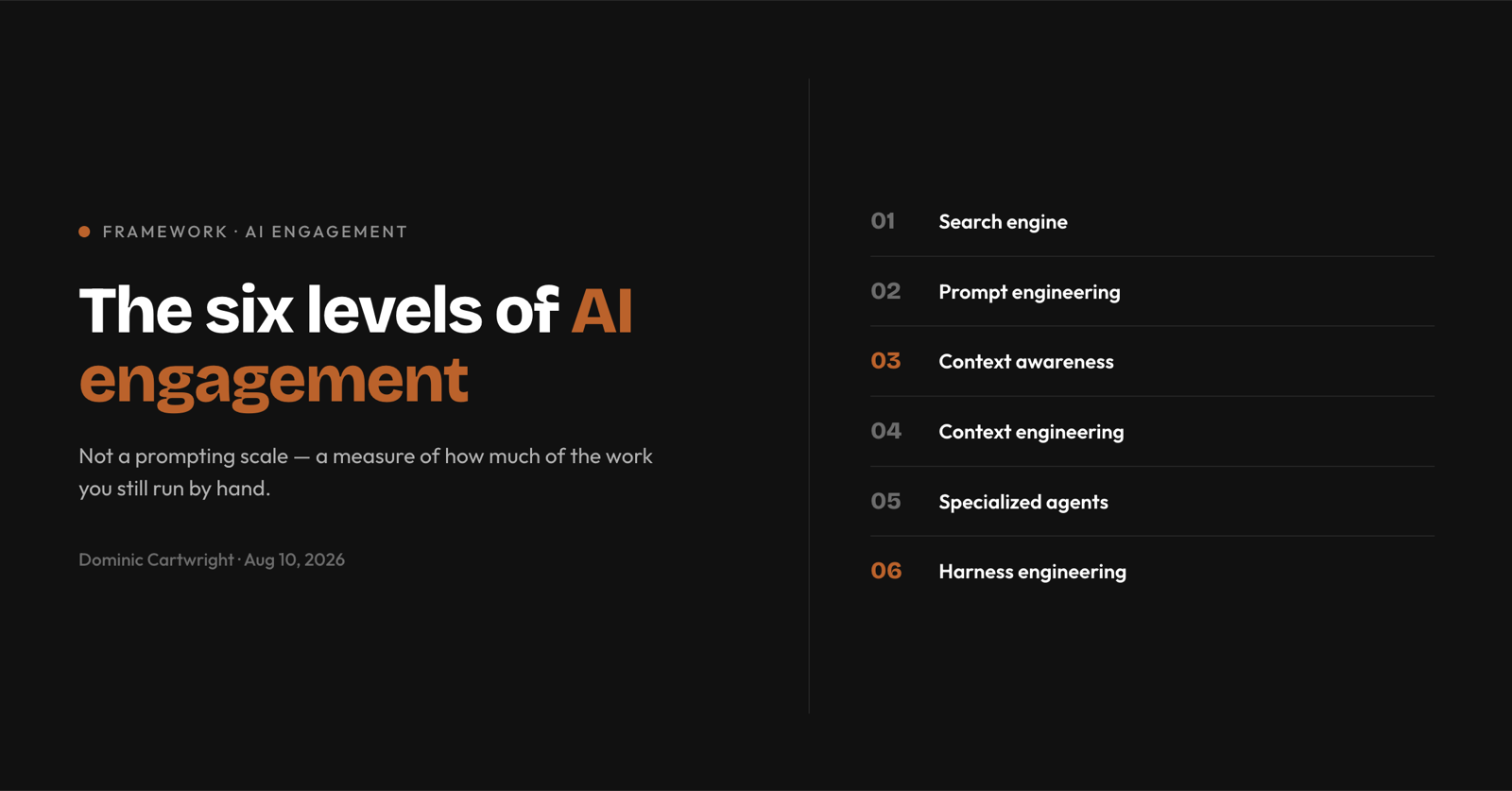
There's a gap between how people talk about AI and how they actually use it. Ask someone if they "use AI" and almost everyone says yes. But that single yes hides enormous variation — the distance between someone who occasionally asks a chatbot a question and someone whose work is run by a fleet of self-directing agents is not a small gap. It's closer to the distance between a person who can drive a car and a person who designs the engine.
I've come to think about that distance as six levels. Not skill levels in the sense of "getting better at prompting," but levels of engagement — how directly a person has to steer the AI versus how much the system has come to run on its own. Each level up the ladder trades manual effort for autonomy. That single axis — manual to autonomous — is the thread that ties the whole framework together, and it's the thing worth understanding before you worry about where you or your team currently sit.
Level 1: Search
This is the entry point, and it's where almost everyone starts. You type a question, the AI gives you an answer. It looks like search, it feels like search, and for most people that's exactly what it is — a faster, more conversational version of looking something up.
The defining trait of this level isn't the quality of the answer. It's the lack of transparency and iteration. You don't see where the answer came from, you don't refine it, you take what you get. It's a single exchange, not a conversation. Most people's very first interaction with a chatbot happens here, and for simple factual questions, it's genuinely all you need.
Level 2: Prompting
The moment someone realizes that how they ask changes what they get, they've moved to Level 2. This is prompt engineering — adding context, specifying format, giving examples, iterating on wording until the output improves.
This is also where the overwhelming majority of AI users live, permanently. Chat is the tool, as far as they're concerned. And it's easy to see why: the return on learning to prompt well is immediate and satisfying. A better-worded question really does produce a better answer. The problem is that this feedback loop creates a ceiling of its own — once someone gets good at prompting, there's little visible incentive to look for the next level, because the tool already feels like it's working.
Level 3: Context Awareness
The shift into Level 3 usually comes from a specific kind of frustration: the AI keeps giving generic, slightly-off answers, no matter how carefully the prompt is worded. The realization that follows is important — the problem was never the phrasing. It was that the AI never actually had the material it needed.
At this level, people start attaching things: documents, codebases, spreadsheets, transcripts, whatever the real substance of the problem actually is. The quality jump here tends to be the most dramatic of any transition in the framework, because it's the first time the AI is working from your actual reality instead of its general assumptions about what someone in your position might be asking...
The rest of the framework — Context Engineering, Specialized Agents, Harness Engineering, and why it's a stack rather than a ladder — continues on Substack.
Continue reading on Substack →